Beyond the Anxious Generation: Are We Banning the Wrong Thing?
Protecting childhood, developing independent thinkers and preparing our children for a digital future
With contributions from Emma Sokolsky, Melissa Slaymaker and Mpho Hlalele
In this article
Executive summary
There is a growing international movement among parents to remove digital devices from schools, particularly in primary schools and the earlier years of secondary education.
Much of this movement has been influenced by Jonathan Haidt’s bestselling book, The Anxious Generation, and concerns that technology is contributing to declining mental health, fragmented attention, reduced physical activity and the disappearance of a traditional, play-based childhood.
At HelloAida, we share many of these concerns.
Children should spend more time outdoors, playing, reading, creating, developing friendships, interacting with their families and experiencing the world beyond a screen.
Unrestricted access to smartphones, social media and algorithm-driven entertainment presents significant developmental risks.
They must also develop foundational literacy, numeracy, memory, concentration, creativity and independent thinking.
However, we also believe that an important distinction is being lost in this debate.
There is a fundamental difference between a child using technology to learn and a child being consumed by technology.
A learner spending 30 minutes researching a school project, practising mathematics or receiving guided educational support is not necessarily having the same cognitive or developmental experience as a child spending three hours scrolling through social media, watching Netflix or consuming algorithmically selected videos.
Yet increasingly, these activities are grouped together under a single, highly emotive term: screen time.
Although Haidt’s work has profoundly influenced public opinion, his central causal arguments remain the subject of substantial scientific disagreement. Academic responses published in Nature, Science and other research publications demonstrate that the relationship between technology and childhood development is considerably more complex than many public discussions suggest.
Drawing on more than two decades of research, HelloAida advocates an approach that protects childhood while developing the technological competence children will need throughout their lives.
Before removing educational technology from schools, we need to ask whether we are addressing the real problem, interpreting the research correctly and genuinely preparing children for the world they will inherit.
We also need to have a considerably more uncomfortable conversation about what happens when children leave school and return home.
1. How the research has evolved: More than two decades of scientific investigation
The debate about technology and childhood did not begin with Jonathan Haidt in 2024.
Researchers have spent decades investigating the relationship between technology, learning, memory, cognitive development, social interaction and mental wellbeing.
Older studies are not automatically invalidated by newer publications. Many provide the scientific foundations upon which contemporary research is built.
Period | Research emphasis |
2003–2010 | Can technology improve education? Research examined calculators, computer-assisted instruction and how digital resources could complement traditional teaching. The emphasis was on educational outcomes. |
2011–2015 | How does technology change the way we think? Researchers investigated internet-based memory, digital distraction and multitasking. Sparrow and colleagues’ landmark 2011 study introduced important questions about external memory. |
2016–2020 | What are the cognitive and developmental risks? Research expanded into cognitive offloading, smartphone restrictions, reading comprehension, adolescent wellbeing and the developmental importance of play. |
2021–2024 | What happens when technology becomes pervasive? Researchers investigated pandemic-related digital habits, family screen use, educational inequality, social media and the emergence of generative AI. Haidt brought these concerns into mainstream public discussion. |
2025–2026 | Which interventions actually work? Research increasingly examines school smartphone restrictions, educational AI safeguards, developmental needs and the distinction between performance with technology and independent learning. |
The evolution of this research reveals an important shift.
The question is no longer simply whether technology is beneficial or harmful.
It is increasingly about which technologies, used for which purposes, by which children, under which conditions, produce which outcomes.
Educational policy should reflect this increasingly sophisticated understanding rather than reverting to an indiscriminate debate about whether screens are good or bad.
2. Jonathan Haidt and The Anxious Generation: Where we agree and where we differ
Jonathan Haidt has made an important contribution to the international conversation about childhood.
Published in March 2024, The Anxious Generation: How the Great Rewiring of Childhood Is Causing an Epidemic of Mental Illness argues that childhood has undergone a fundamental transformation through the replacement of play-based experiences with phone-based experiences.
Haidt identifies four principal harms:
Social deprivation.
Sleep deprivation.
Attention fragmentation.
Addiction.
His broader argument is that society has become increasingly protective of children in the physical world while failing to protect them adequately in the digital world.
This concern deserves serious attention.
Where HelloAida agrees with Haidt
Haidt’s recommendation | HelloAida’s position |
No smartphones before high school | We support delaying unrestricted smartphone ownership. |
No social media before 16 | We support strong, age-appropriate restrictions. |
Phone-free schools | We support restricting personal smartphones and recreational digital distractions. |
More independence, free play and responsibility | We strongly support this, both at school and at home. |
We believe children need substantially more opportunities for meaningful interaction, physical activity, creativity, outdoor play and independence.
We also recognise that many commercial digital platforms have been designed to maximise engagement rather than promote children’s wellbeing.
Our disagreement is not about whether children require protection. It is about whether that protection should extend to removing appropriately designed and supervised educational technology.
A phone-free school does not have to be a technology-free school.
The danger of extending smartphone research to educational technology
As the conversation initiated by Haidt has expanded, opposition to smartphones and social media has increasingly extended to educational computers, tablets, digital learning platforms and artificial intelligence.
We believe this extrapolation requires greater scientific scrutiny.
Research demonstrating potential harms associated with social media cannot automatically be applied to supervised mathematics software.
Research examining compulsive smartphone behaviour cannot automatically be applied to teacher-directed research projects.
Research involving adolescents cannot automatically determine educational policy for younger primary school children.
The device, activity, duration, developmental stage, educational purpose and degree of supervision all matter.
Source: Jonathan Haidt, The Anxious Generation, 2024.
3. When public opinion moves faster than scientific consensus: The academic challenge to Jonathan Haidt
Although The Anxious Generation has become enormously influential, Haidt’s interpretation of the scientific evidence is not universally accepted.
Since its publication, the book has helped influence parenting decisions, school technology policies and government interventions internationally. Its influence is understandable. It addresses genuine parental concerns and offers seemingly straightforward solutions to complex developmental challenges.
However, the academic response has been considerably more nuanced than the public response.
At HelloAida, we believe it is essential that parents, educators and school governing bodies understand the full scientific debate before making decisions that could fundamentally change children’s educational experiences.
Orben and Przybylski, 2019: Is the relationship as strong as we think?
In 2019, researchers Amy Orben and Andrew Przybylski published a major study in Nature Human Behaviour examining the relationship between adolescent wellbeing and digital technology use.
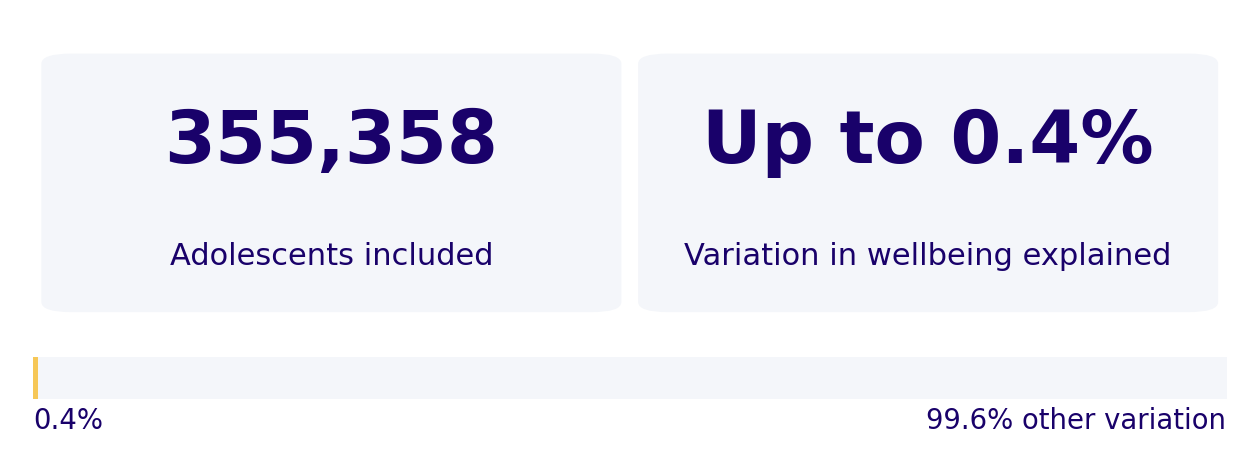
355,358 adolescents; up to 0.4% of variation in wellbeing explained by digital technology use.
The researchers found that the association between broad digital technology use and adolescent wellbeing was small at population level.
This challenges the assumption that digital technology, considered as a broad category, is a dominant explanation for declining adolescent wellbeing.
It does not establish that social media is harmless or that particular children cannot experience substantial negative consequences. Rather, it demonstrates the importance of distinguishing between different digital activities, individual vulnerabilities and wider social circumstances.
Professor Candice Odgers: Challenging the causal narrative
In March 2024, Professor Candice Odgers, a developmental psychologist specialising in adolescent mental health and digital technology, published a critical review of Haidt’s book in Nature.
Odgers challenged the strength of the scientific evidence supporting Haidt’s central causal claims.
She highlighted that much of the available research was correlational and that studies had produced inconsistent findings, including negative, positive and statistically insignificant associations.
Her concern was not that digital technology presents no risks. Rather, she questioned whether the available evidence justified identifying smartphones and social media as the principal causes of the adolescent mental-health crisis.
She also warned that an excessive focus on technology could divert attention from other important contributors to children’s mental health.
These include economic hardship, family circumstances, academic pressures, social isolation, access to mental-health services and pre-existing psychological vulnerabilities.
The editor-in-chief of Science enters the debate
In June 2024, H. Holden Thorp, editor-in-chief of Science, published an editorial entitled Unsettled Science on Social Media.
Thorp drew attention to the disparity between the enormous public reach of Haidt’s book and the considerably less visible scientific debate surrounding its conclusions.
While The Anxious Generation received extensive mainstream media coverage, much of the academic criticism remained within scientific publications that ordinary parents and educators were less likely to encounter.
This raises an important concern for educational policymakers.
The widespread popularity of a scientific argument should not be confused with widespread scientific agreement.
Parents may understandably assume that the recommendations presented in a bestselling book reflect an established academic consensus. In this instance, important scientific questions remain unresolved.
Source: H. Holden Thorp, Unsettled Science on Social Media, Science, June 2024
Academic criticism of Odgers must also be acknowledged
Scientific scrutiny works in both directions.
In May 2024, Michael A. Spikes published a correspondence in Nature challenging aspects of Odgers’ criticism.
Spikes argued that focusing narrowly on individual causal relationships could overlook Haidt’s broader argument concerning collective changes in childhood, social norms and the displacement of traditional experiences.
This is a legitimate consideration.
Even where establishing direct causation is difficult, changes in how children collectively socialise, play and communicate deserve investigation.
At HelloAida, we acknowledge these concerns. We support restoring opportunities for free play, meaningful relationships, physical activity and independence.
However, these objectives do not inherently require the elimination of supervised educational technology.
The National Academies of Sciences, Engineering and Medicine, 2024
The National Academies’ consensus report, Social Media and Adolescent Health, provides an important institutional perspective on the debate.
The report recognises significant risks associated with social media, including harmful content, problematic usage and platform design.
However, it also concludes that the available evidence does not establish that social media causes population-level changes in adolescent health.
The effects of social media can differ substantially between individuals, depending on their circumstances, vulnerabilities and patterns of use.
This does not mean society should wait for absolute scientific certainty before protecting children. Precautionary measures can be justified where credible risks exist.
However, the distinction between precaution and established scientific causation must remain clear.
Haidt and Odgers debate the evidence directly
In October 2024, the University of Virginia hosted a public academic debate between Jonathan Haidt and Candice Odgers.
The discussion exposed fundamental differences in how researchers interpret the available evidence.
Haidt defended the need for strong precautionary interventions, while Odgers questioned whether the magnitude and consistency of available findings justified his causal conclusions.
Both recognised the importance of children’s mental health. Their disagreement concerned the underlying causes, the interpretation of scientific evidence and the most appropriate interventions.
This is precisely the kind of intellectual debate that should inform educational policy.
Source: University of Virginia, Mental Health and Social Media
2025–2026: More than 120 researchers evaluate the scientific evidence
The debate subsequently expanded beyond individual academics.
In May 2025, researchers led by Valerio Capraro, Laura Globig, Steve Rathje and Jay Van Bavel published a collective review examining commonly cited claims about smartphones, social media and adolescent mental health.
The manuscript was revised on 17 September 2026.
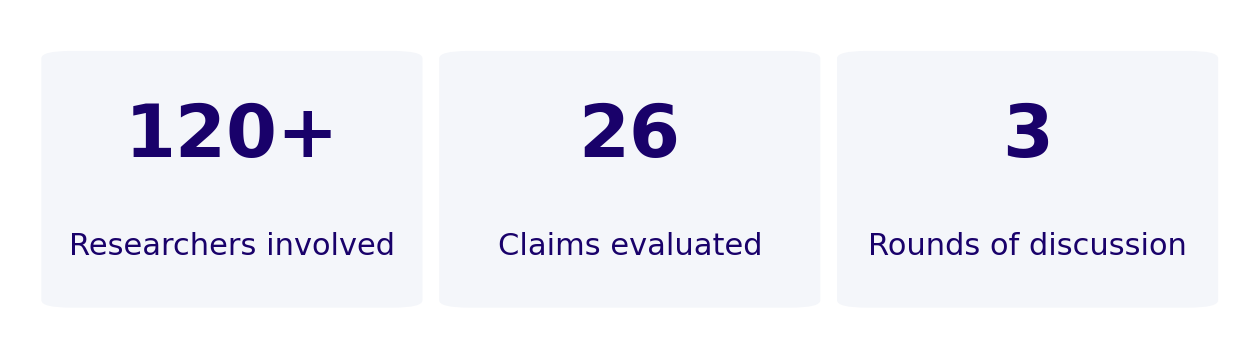
120+ researchers involved; 26 scientific claims evaluated; 3 rounds of academic discussion.
Using a structured Delphi process, researchers with diverse perspectives evaluated the available evidence. Haidt himself was involved in developing the claims under investigation.
The researchers identified several areas of agreement, including the deterioration of adolescent mental health in several Western countries and the risks associated with heavy smartphone and social media use.
Area investigated | Scientific assessment |
Declining adolescent mental health | Broad agreement in several Western countries |
Heavy usage and sleep disruption | Evidence supporting a causal relationship |
Heavy usage and attention difficulties | Evidence of association |
Problematic or addictive usage | Recognised concern |
Social media and body dissatisfaction among girls | Evidence of association |
Many other claims concerning digital technology and mental health | Limited, inconsistent or insufficient causal evidence |
The researchers also identified methodological challenges, geographical biases and the importance of considering unintended consequences when developing restrictive policies.
This is particularly significant because it demonstrates that uncertainty about Haidt’s broader causal framework is not confined to one or two dissenting academics.
Nevertheless, the September 2026 version remains a working paper and should not be presented as a final peer-reviewed consensus publication.
November 2026: Continuing disagreement among mental-health professionals
Further research published on 19 November 2026 by Christopher Ferguson and colleagues in Discover Psychology examined whether clinicians and clinical researchers shared a common understanding of the relationship between social media and youth mental health.
The study surveyed 129 mental-health clinicians and clinical researchers, predominantly from North America and Europe.
The researchers found that social media generally ranked relatively low among respondents as a perceived contributor to youth mental-health problems.
Many respondents acknowledged potential harms while also recognising potential benefits. Majorities expressed reservations about social media bans and concerns about the quality of the existing scientific evidence, although substantial minorities held opposing views.
This research challenges the perception that clinical and scientific communities have reached a unified position.
However, the study measures professional opinion rather than directly establishing the effects of technology on children. Its sample should not be assumed to represent all mental-health professionals internationally.
Haidt’s continuing defence of his position in 2026
For academic credibility, we must also acknowledge that Haidt has continued to defend his conclusions.
In the World Happiness Report 2026, Haidt and Zachary Rausch argued that evidence from multiple research methodologies, including longitudinal studies, experiments, surveys and natural experiments, provides compelling grounds for concluding that social media has contributed to adolescent mental-health deterioration at population level.
They also highlighted direct online harms, such as cyberbullying and sexual exploitation, alongside indirect psychological risks.
These concerns deserve serious attention.
October 2026: Haidt’s own research reinforces the need to distinguish digital activities
Interestingly, on 20 October 2026, Haidt and Rausch published a paper in Perspectives on Psychological Science entitled Two Practices That Understate the Mental Health Risks Associated With Adolescent Social-Media Use.
The authors argued that combining different digital activities, demographic groups and psychological outcomes can obscure important risks.
For example, aggregating television viewing with social media usage, or combining boys and girls in broad analyses, may conceal harms experienced by particular populations.
This methodological principle has important implications for educational policy.
If researchers must distinguish between fundamentally different digital activities when investigating psychological harm, surely the same principle should apply when evaluating educational technology.
A child completing a supervised mathematics exercise should not automatically be placed in the same category as a child compulsively scrolling through social media.
A curriculum-aligned AI tutor should not automatically be evaluated in the same way as an unrestricted general-purpose chatbot.
A teacher-directed research project should not automatically be equated with hours of algorithm-driven entertainment.
Haidt and Rausch’s research does not independently establish the benefits of educational technology. However, their methodological argument reinforces the importance of evaluating specific digital activities rather than treating all technology exposure as equivalent.
Source: Haidt and Rausch, Perspectives on Psychological Science, October 2026
Correlation is not causation
One of the most important scientific distinctions in this debate is the difference between correlation and causation.
If children who spend more time online report higher levels of anxiety, several explanations are possible.
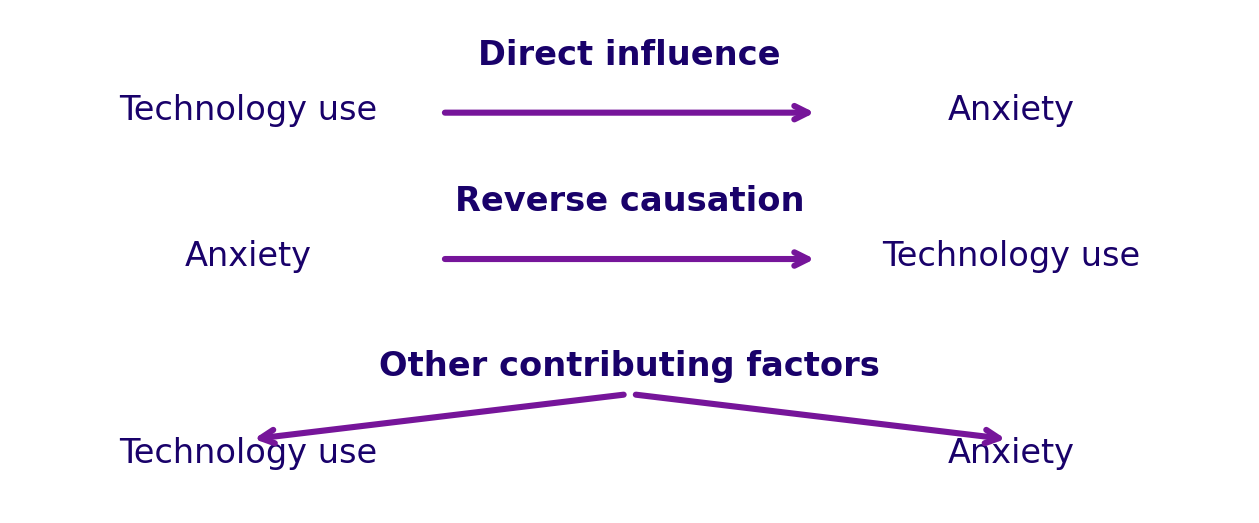
Possible causal relationships: direct influence, reverse causation and other contributing factors.
These relationships may also reinforce one another. Different mechanisms may operate in different children.
This complexity matters because interventions based on an incomplete understanding of causation may fail to address the underlying problem.
Removing a device may reduce one source of distraction or distress. It does not necessarily resolve the wider psychological, social or family circumstances affecting a child.
What the cumulative scientific evidence tells us
Scientific question | Current interpretation |
Are children experiencing significant mental-health challenges? | Yes, although patterns vary across populations. |
Can excessive recreational technology displace sleep and play? | There are substantial grounds for concern. |
Can particular online experiences harm vulnerable children? | Yes, with risks varying by activity and individual circumstances. |
Is social media the principal cause of the adolescent mental-health crisis? | This remains scientifically contested. |
Do all digital activities produce equivalent developmental outcomes? | The evidence does not support treating them as equivalent. |
Are blanket educational device bans the most effective intervention? | This has not been established. |
The danger of translating public anxiety into educational policy
Parents are understandably concerned about their children’s wellbeing. They want straightforward answers and effective solutions.
However, educational policy must be informed by the cumulative scientific evidence rather than exclusively by the most influential public narrative.
At HelloAida, we are not arguing against Haidt’s desire to protect childhood. We share many of his objectives.
We are challenging the extension of concerns about unrestricted smartphones and social media into blanket opposition to educational technology.
The evidence warrants precaution. It warrants responsible regulation, age-appropriate boundaries, parental involvement, greater opportunities for play and stronger technological safeguards.
What it does not establish is that every form of educational technology should be removed from children’s lives.
The objective should be evidence-based protection, not fear-based prohibition.
4. Do school device bans actually work?
There is considerable international momentum behind school mobile phone restrictions.
According to UNESCO’s September 2026 update, 114 education systems, representing approximately 58% of countries worldwide, now have national school mobile phone bans.
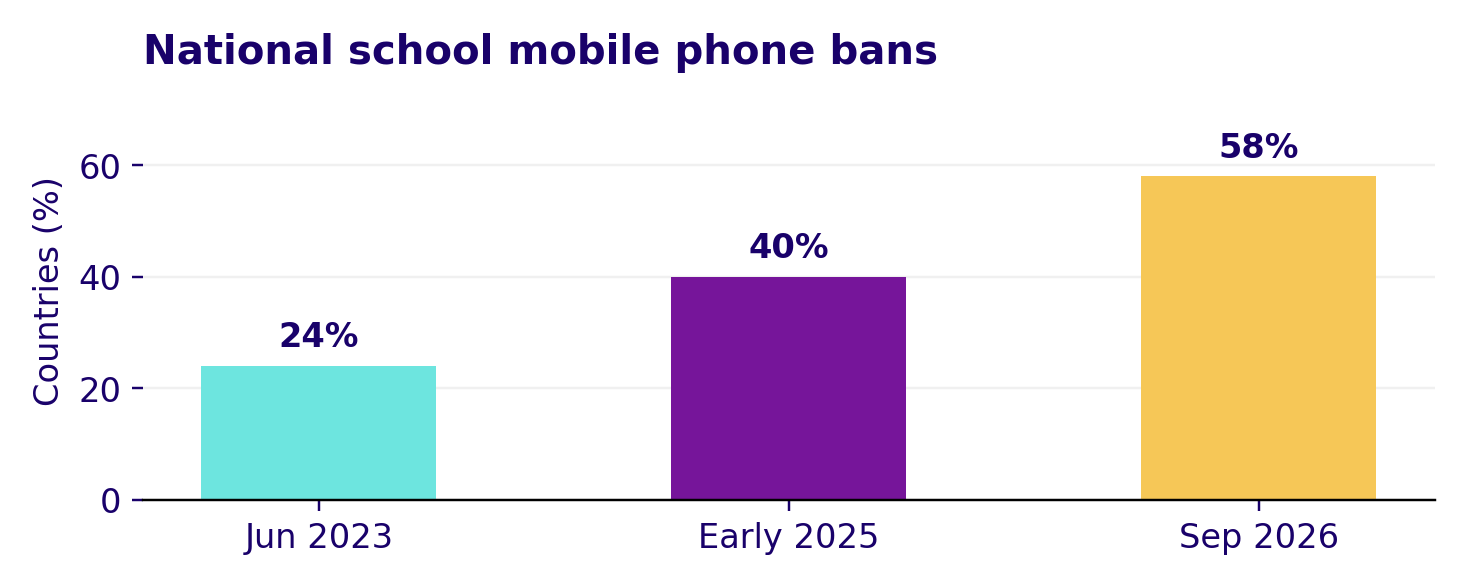
Percentage of countries with national school mobile phone bans: June 2023 24%, early 2025 40%, September 2026 58%. Source: UNESCO Global Education Monitoring Report, September 2026.
However, the popularity of a policy does not independently establish its effectiveness.
Furthermore, these restrictions predominantly concern mobile phones. They should not automatically be interpreted as international support for removing all educational computers and digital learning resources.
2016: Evidence supporting school mobile phone bans
In their 2016 study, Ill Communication: Technology, Distraction & Student Performance, Louis-Philippe Beland and Richard Murphy examined mobile phone restrictions in English schools.
Researchers identified improvements in examination performance following phone bans, particularly among lower-performing learners.
This provides an important argument for reducing digital distractions in classrooms.
HelloAida supports this principle.
However, the intervention examined mobile phone restrictions, not the removal of all supervised educational computers.
Source: Beland and Murphy, Labour Economics, 2016
2025: The landmark SMART Schools study
One of the most important studies for understanding school smartphone policies was published in February 2025 in The Lancet Regional Health – Europe.
The SMART Schools study, led by researchers at the University of Birmingham, examined the relationship between school phone policies, mental wellbeing and overall phone and social media use.
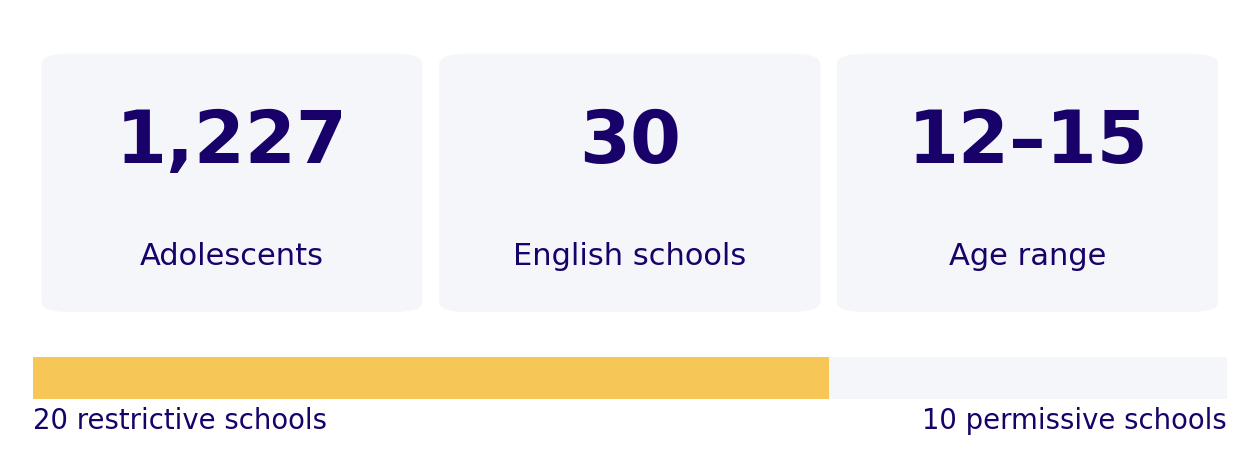
1,227 adolescents aged 12–15 in 30 English schools; 20 restrictive and 10 permissive policies.
The researchers found that adolescents attending schools with restrictive phone policies spent less time using phones and social media during school hours.
However, they did not find evidence of lower overall weekday or weekend usage or better mental wellbeing.
Outcome | Findings associated with restrictive school phone policies |
Phone usage during school | Approximately 40 minutes less |
Social media usage during school | Approximately 32 minutes less |
Overall weekday phone usage | No significant difference detected |
Weekend phone usage | No significant difference detected |
Mental wellbeing | No significant difference detected |
These findings deserve particular attention.
The policies were associated with less phone use during school. However, the differences did not extend to overall usage and mental wellbeing.
Because the study was cross-sectional and observational, it cannot establish that all phone bans are ineffective or that children necessarily compensate by increasing their usage at home.
Nevertheless, it demonstrates why school policies must be considered within children’s wider digital environments.
Source: Goodyear et al., SMART Schools Study, The Lancet Regional Health – Europe, 2025
October 2026: National American evidence on school phone bans
Research published by Hunt Allcott and colleagues in The Quarterly Journal of Economics on 30 October 2026 examined the consequences of restricting personal smartphones using lockable phone pouches.
The researchers combined nationwide data from teacher surveys, standardised assessments, school administrative records and measures of phone usage.
This represents an important effort to move beyond anecdotal accounts and assess measurable consequences of school phone restrictions.
However, the intervention specifically concerns personal mobile phones. It cannot independently establish the educational consequences of removing supervised educational computers or AI-assisted learning resources.
October 2026: School phone bans and adolescent mental health in Iceland
Particularly significant research was published in JAMA Network Open on 27 October 2026.
Professor Candice Odgers was among the contributing authors.
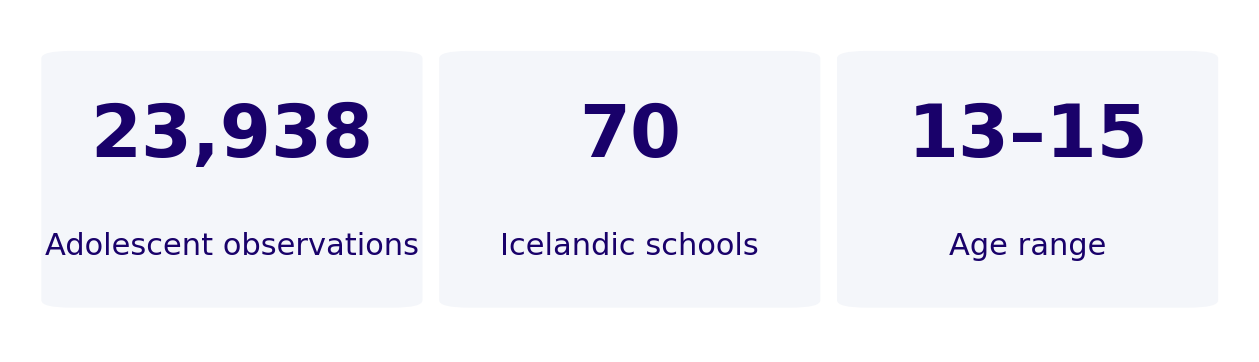
23,938 adolescent observations; 70 Icelandic schools; ages 13–15.
Using survey data collected in 2016, 2018 and 2023, researchers compared changes in mental health and related outcomes between schools that introduced phone bans and those that did not.
They found no meaningful mental-health improvements attributable to the restrictions. Nor did the results demonstrate clear improvements in peer support, bullying or daily recreational screen use.
Importantly, the researchers acknowledged that phone bans could still provide benefits for classroom concentration, instructional time or engagement, which were not assessed in the study.
Their findings support considering phone restrictions as part of a broader strategy rather than expecting a single school rule to resolve complex adolescent mental-health challenges.
What does the cumulative evidence tell us?
Research spanning 2016 to 2026 supports taking smartphone distraction seriously.
Some studies identify academic benefits associated with restrictions. Others identify limited benefits for overall technology use or mental wellbeing.
These findings are not necessarily contradictory. Different studies investigate different populations, interventions and outcomes.
At HelloAida, we support proportionate restrictions on personal smartphones and recreational digital distractions.
However, evidence supporting personal smartphone restrictions should not automatically be interpreted as evidence supporting the elimination of educational computers.
5. The great screen-time misconception
One of the most significant weaknesses in the current debate is the treatment of screen time as a uniform activity.
Screen time measures duration. It does not measure intellectual engagement, educational quality, developmental appropriateness or the nature of the experience.
Consider the following activities.
Purposeful educational technology | Recreational digital consumption |
Practising mathematics | Compulsive social media scrolling |
Researching a science project | Endless algorithmically selected videos |
Receiving personalised educational feedback | Extended passive entertainment |
Learning a new language | Unrestricted online browsing |
Creating a digital presentation | Repeatedly checking notifications |
Developing programming skills | Excessive recreational gaming |
Learning through guided questioning | Seeking instant digital gratification |
All of these activities involve screens.
They do not necessarily have identical intellectual or developmental consequences.
Of course, recreational technology can sometimes be creative, educational and socially valuable, while educational technology can be ineffective, distracting or poorly designed.
The distinction therefore extends beyond whether an activity is labelled educational. It concerns the quality, purpose, duration and design of the experience.
The American Academy of Pediatrics’ updated 2026 guidance
In January 2026, the American Academy of Pediatrics published its updated policy statement, Digital Ecosystems, Children, and Adolescents.
The guidance recognises the importance of platform design, children’s developmental needs, family environments and the activities displaced by technology.
Rather than treating all digital experiences identically, it considers the wider ecosystem in which children use technology.
Source: American Academy of Pediatrics, Digital Ecosystems, Children, and Adolescents, January 2026
The evidence concerning excessive screen exposure
A September 2026 quantitative umbrella review published in JAMA Pediatrics identified associations between screen use and several less favourable developmental outcomes, including language development, academic achievement and emotional and behavioural difficulties.
Importantly, findings varied according to children’s ages and the types of screen use investigated.
At HelloAida, we take such findings seriously.
Educational technology must earn its place in a child’s day. Its educational purpose does not justify unlimited exposure.
A screen is a medium. What happens through that medium, and what it displaces, should determine its educational value.
6. The evidence for educational technology: More than two decades of learning research
The argument for retaining educational technology should not rest exclusively on preparing children for the future.
Technology must also demonstrate educational value in the present.
2011: Forty years of research into educational technology
In 2011, Tamim and colleagues published a second-order meta-analysis in Review of Educational Research, examining four decades of research into the impact of technology on learning.
The researchers identified an overall positive effect of educational technology on learning outcomes, although effects varied considerably between interventions.
The importance of this research lies in its cumulative perspective. Educational technology had already been investigated extensively long before the emergence of smartphones, contemporary social media or generative AI.
2019: Experimental evidence from a developing country
Muralidharan, Singh and Ganimian published a randomised evaluation of a personalised, technology-supported educational programme for middle-school learners in urban India.
After approximately four and a half months, learners offered access achieved:
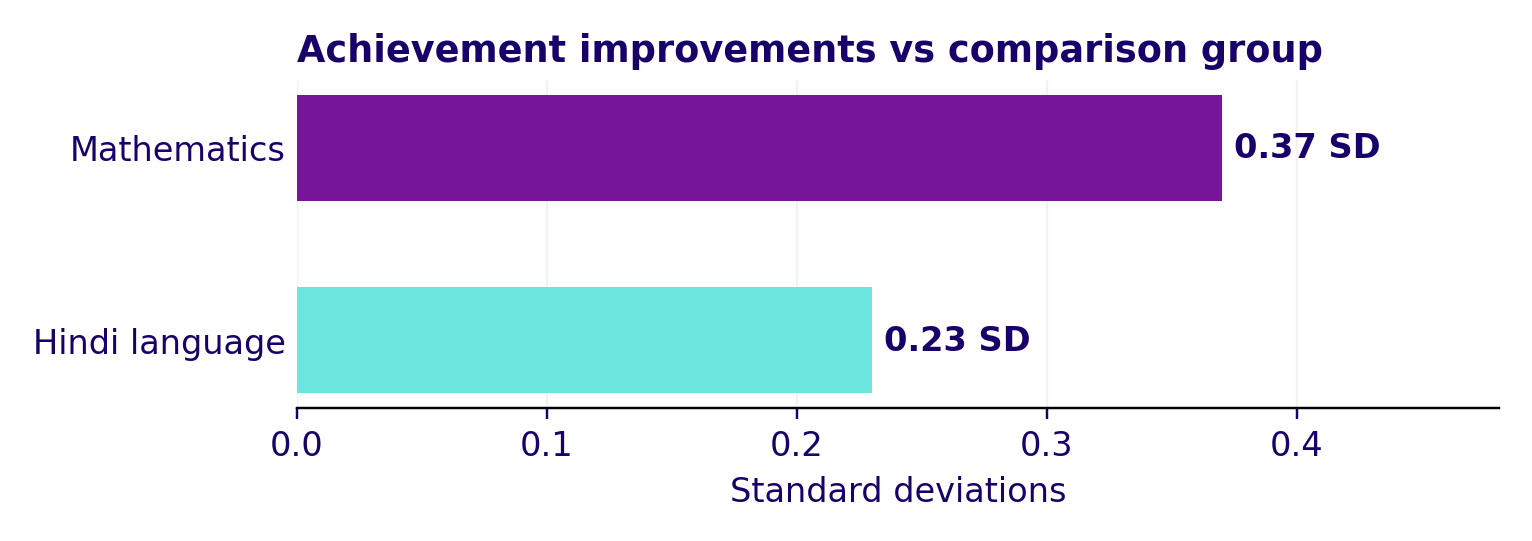
Achievement improvements relative to comparison group: mathematics 0.37 SD; Hindi language 0.23 SD. SD = standard deviations.
The intervention combined educational technology with a structured after-school programme, so its effects cannot be attributed to devices alone.
Nevertheless, it demonstrates that appropriately designed technology-supported instruction can make a meaningful contribution to learning, including in developing-country environments.
2023: OECD evidence on moderate educational technology use
The OECD’s PISA 2022 research examined relationships between digital device use and mathematics performance.
Learners reporting up to one hour of educational device use per school day achieved higher average mathematics scores than learners reporting no educational device use.
The performance advantage was approximately 14 PISA mathematics points after accounting for socioeconomic circumstances.
These are observational findings involving predominantly 15-year-old learners. They do not establish that introducing technology automatically improves mathematics performance, nor do they establish a universal screen-time recommendation for primary school children.
However, they challenge the assumption that zero educational technology necessarily produces the best educational outcomes.
Source: OECD, PISA 2022 Results, Volume II, published 2023
September 2026: The American Psychological Association examines educational technology
The American Psychological Association’s 2026 report concerning children’s and adolescents’ learning with educational technology raises important considerations for educators.
Engagement should not automatically be interpreted as learning. Attention-grabbing digital features can interfere with learning, while artificial intelligence can potentially improve the quality of children’s completed work without improving their underlying intellectual abilities.
We welcome this scrutiny.
The most important measure of educational technology is not how well children perform while using it, but what they can do independently after they stop using it.
Technology should strengthen teaching, not replace it
The Education Endowment Foundation’s guidance identifies several areas in which appropriately selected educational technology can support effective learning, including assessment, feedback, practice and instructional quality.
Its emphasis is on effective pedagogy rather than the presence of technology.
A laptop is not an educational strategy. A tablet is not a curriculum. Artificial intelligence is not a substitute for a qualified teacher.
Technology should provide teachers with additional opportunities to support individual learners, particularly where children require more explanation, practice or encouragement than classroom time permits.
Source: Education Endowment Foundation, Using Digital Technology to Improve Learning, 2019
What HelloAida itself is seeing
While the evidence above is drawn from independent, peer-reviewed research, HelloAida is also accumulating its own operational experience.
Since its public launch in March 2026, following an earlier six-month school trial, HelloAida has grown to several thousand learners across nine live schools, including Grey High School, Sinenjongo High School and Sea Point High School.
An informal, school-led trial at Edgemead Primary produced encouraging early results.
Because it was not independently designed or peer-reviewed, we treat it as directional rather than conclusive evidence.
HelloAida has also begun a formal research partnership, with an independent researcher analysing anonymised platform chat data, and is scoping a path toward university-partnered, ethically cleared academic publication of these findings.
We set this out not as proof of efficacy, but in the spirit of the rest of this paper: we are prepared to subject our own claims to the same scrutiny we are asking of the research under discussion.
7. Beyond the school gates: The role and responsibility of parents
Much of the current debate places considerable responsibility on schools.
Schools are expected to protect children from inappropriate content, distraction, cyberbullying, excessive screen exposure and technological dependence.
These expectations are reasonable within the environments schools control.
However, schools cannot independently regulate children’s entire digital lives.
Where schools demonstrate that their device use is minimal, supervised and educationally meaningful, parents must also examine what happens during the remaining hours of their children’s day.
Are we targeting the largest source of the problem?
Consider the following hypothetical example.
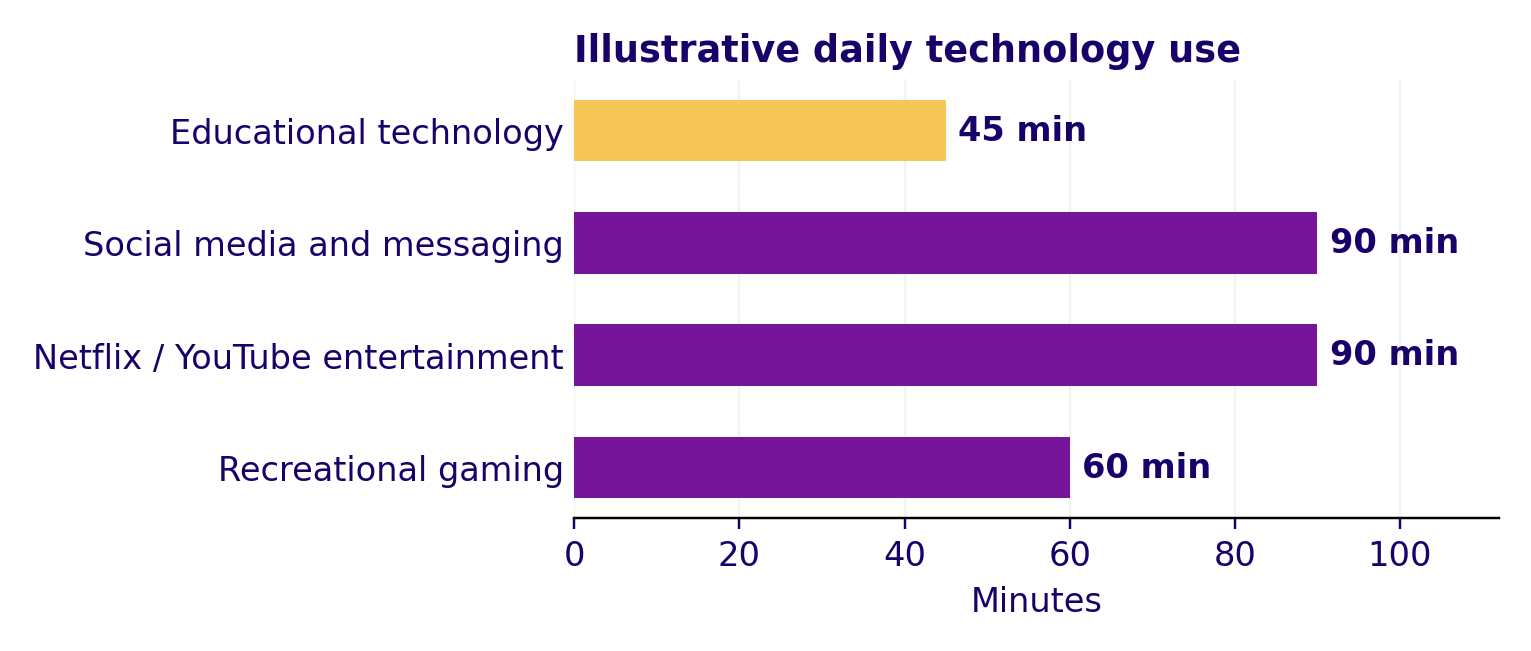
Illustrative daily technology use: 45 minutes of educational use and 240 minutes of recreational use, comprising 90 minutes of social media and messaging, 90 minutes of Netflix and YouTube, and 60 minutes of gaming. Educational use 16%, recreational use 84%. Not measured population data.
If the parents of this child successfully campaign to remove educational technology from school but make no changes to recreational technology habits at home, four hours of recreational consumption remain.
They may have reduced total screen exposure, but they have not directly addressed the child’s relationship with recreational technology.
They have not necessarily reduced social media dependence, improved bedtime routines, created additional family time or encouraged more outdoor activity.
The SMART Schools study and the subsequent 2026 Icelandic research reinforce the importance of considering these wider environments.
Are parents adopting Haidt’s recommendations selectively?
Haidt’s four recommendations were intended to work together.
They require changes not only from schools but from families and communities.
Parents campaigning for device restrictions should therefore consider their own digital environments.
Does their child have an unrestricted smartphone?
Do they permit social media before 16?
Are devices allowed in bedrooms overnight?
How much time is spent consuming recreational digital content?
How frequently do families participate in screen-free activities?
Are children given opportunities for independent play?
Do parents model healthy technology habits themselves?
We are not suggesting that every parent supporting device restrictions is neglecting these responsibilities.
We are suggesting that meaningful intervention must extend beyond the school gates.
We cannot selectively embrace the recommendations that require schools to change while overlooking those that require us, as parents, to change.
Schools cannot replace responsible parenting
We recognise that modern parenting is demanding. Parents are navigating technologies that did not exist during their own childhoods while balancing professional commitments, household responsibilities and increasingly complex family schedules.
However, there are responsibilities that cannot reasonably be transferred to schools.
Parents need to understand which applications their children are using, establish appropriate parental controls, regulate recreational screen time, monitor social media access and protect sleep, physical activity and family interaction.
They also need to understand how their children are using artificial intelligence outside school.
A school can regulate what happens within its classrooms. It cannot independently regulate what happens in a child’s bedroom at nine o’clock at night.
A school device policy cannot substitute for an effective family device policy.
8. Protecting childhood: The scientific importance of play
One of Haidt’s most important contributions is his emphasis on restoring play-based childhood.
At HelloAida, we wholeheartedly support this principle.
However, the scientific importance of play was established long before The Anxious Generation was published.
Yogman et al., 2018: The Power of Play
In 2018, Michael Yogman, Andrew Garner, Jeffrey Hutchinson, Kathy Hirsh-Pasek and Roberta Michnick Golinkoff published an influential clinical report through the American Academy of Pediatrics.
Entitled The Power of Play: A Pediatric Role in Enhancing Development in Young Children, the report examines the importance of developmentally appropriate play.
Significantly, the American Academy of Pediatrics reaffirmed the clinical report in January 2025.
It identifies play as an important contributor to:
Developmental capability | Contribution |
Executive functioning | Planning, organising and regulating behaviour. |
Language development | Communication, vocabulary and expression. |
Social competence | Cooperation, negotiation and relationships. |
Emotional regulation | Managing frustration and developing resilience. |
Creativity | Imagination, exploration and original thinking. |
Caregiver relationships | Developing supportive human connections. |
These are precisely the human capabilities that become increasingly valuable in a world where artificial intelligence can automate routine intellectual tasks.
Play is not merely a break from education. It is an essential component of development.
Children need opportunities to run, climb, explore, imagine, create, experiment, negotiate friendships and discover their own interests.
They also need opportunities to experience boredom, initiate their own activities and develop interests that are not dependent on a screen.
Source: Yogman et al., The Power of Play, Pediatrics, 2018, reaffirmed 2025
What happens when families reduce recreational screen use?
A 2024 randomised clinical trial involving 89 families and 181 children and adolescents examined the effects of reducing recreational screen media use for two weeks.
Researchers identified improvements in behavioural difficulties and prosocial behaviour.
A related 2022 randomised trial found that reducing recreational screen media use increased children’s physical activity.
These studies provide experimental evidence that changing family digital habits can produce meaningful short-term benefits.
While further research is needed to establish longer-term outcomes, the studies demonstrate the importance of interventions involving families rather than relying exclusively on schools.
Sources:
Taking away a device is not the same as offering an alternative
Removing technology does not automatically create meaningful childhood experiences.
Adults need to create opportunities for them.
Parents concerned about screen exposure should consider not only how they restrict technology, but how they actively create meaningful alternatives.
Experience | Examples |
Outdoor experiences | Walking, cycling, swimming, sport and exploration. |
Creative experiences | Painting, building, drawing, music and crafting. |
Intellectual experiences | Reading, puzzles, conversations and storytelling. |
Family experiences | Cooking, board games, shared meals and uninterrupted time together. |
These experiences do not need to involve expensive outings or elaborate entertainment. Sometimes the most valuable thing a parent can give a child is uninterrupted attention. Children also need opportunities for independent play without constant adult entertainment or supervision beyond what is developmentally appropriate.
A return to play-based childhood requires more than a change in school policy. It requires changes in how adults organise children’s lives.
Parents must model the behaviour they expect
Children learn through observing adults.
It is difficult to teach children that technology should not dominate their lives when adults themselves continually interrupt conversations to check messages, scroll through social media during family dinners or spend evenings consumed by their own digital devices.
Family technology boundaries should apply to everyone.
A screen-free meal should mean a screen-free meal for the entire family.
The American Academy of Pediatrics’ 2026 technical report recognises that children’s digital habits are influenced by caregivers, family environments and the wider systems in which technology operates.
If we want our children to rediscover the value of life beyond a screen, we must make time to share that life with them.
9. From calculators to artificial intelligence: Every generation experiences technological change
Throughout history, technological innovations have transformed the way humans acquire knowledge, communicate and solve problems.
Each innovation has required education systems to reconsider which skills children need to develop independently and which tasks can appropriately be supported by tools.
Innovation | Educational concern | Educational opportunity |
Written records | Reduced reliance on memorisation | Preservation of knowledge |
Printed books | Dependence on written information | Broader educational access |
Calculators | Dependence on automated arithmetic | Exploration of advanced mathematics |
Computers | Distraction and dependence | Programming, analysis and creation |
Internet search | Superficial research and misinformation | Access to extensive information |
Mobile phones | Constant distraction and compulsive use | Portable communication and information |
Generative AI | Outsourcing intellectual effort | Personalised explanations and feedback |
History does not prove that every new technology will ultimately be beneficial.
Social media and artificial intelligence introduce risks that differ considerably from those associated with calculators or printed books.
However, history illustrates the importance of adapting education as technological capabilities evolve.
The calculator analogy
A calculator may undermine learning if a child uses it instead of acquiring basic number sense.
However, once those foundational skills have been developed, a calculator may enable a learner to explore more sophisticated mathematical relationships.
In 2003, researcher Aimee Ellington published a meta-analysis of 54 studies examining the effects of calculators in precollege mathematics.
The research identified benefits associated with appropriately integrated calculator use, including mathematical performance and attitudes towards mathematics.
The learning objective determines whether using a calculator is appropriate.
Artificial intelligence presents a similar educational question, although on a substantially larger intellectual scale.
10. Sparrow et al.: How technology changes human memory
In 2011, researchers Betsy Sparrow, Jenny Liu and Daniel Wegner published a landmark paper in the scientific journal Science.
Entitled Google Effects on Memory: Cognitive Consequences of Having Information at Our Fingertips, the research examined how access to external information changes the way people remember information.
Across four studies, researchers found that when participants expected information to remain accessible in the future, they were less likely to remember the information itself and more likely to remember where it could be accessed.
The researchers described this through the concept of external or transactive memory.
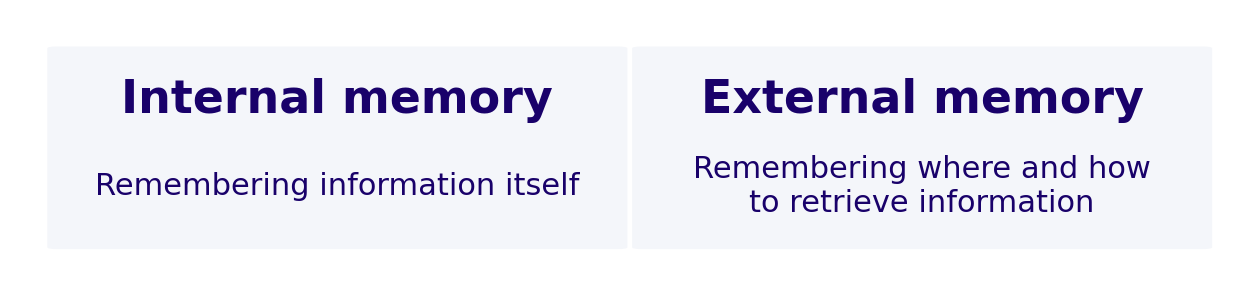
Internal memory: remembering information itself. External memory: remembering where and how to retrieve information. Conceptual illustration of Sparrow and colleagues’ research.
This research is particularly relevant today, when artificial intelligence is extending the availability of external cognitive assistance.
The study does not establish that accessing information online makes people less intelligent.
Nor does it establish that reduced memorisation necessarily improves higher-order thinking.
It demonstrates that the availability of external information can change memory strategies.
This raises an important educational question.
Which knowledge must children retain internally, and which information can appropriately be retrieved through external resources?
Children must develop sufficient foundational knowledge to reason independently, evaluate information and recognise when technology produces incorrect answers.
Education must also teach children how to locate, evaluate, synthesise and apply information effectively.
In a world where information is increasingly accessible, the ability to interpret, question and apply knowledge becomes particularly important.
Knowing where to find information is valuable. Knowing enough to understand and evaluate that information is indispensable.
Source: Sparrow, Liu and Wegner, Google Effects on Memory, Science, 2011
11. Risko and Gilbert: Responsible cognitive offloading
In 2016, cognitive scientists Evan Risko and Sam Gilbert published a foundational review entitled Cognitive Offloading in Trends in Cognitive Sciences.
Cognitive offloading describes the use of external actions or tools to reduce the cognitive demands of a task.
Humans have engaged in cognitive offloading throughout history.
Writing a shopping list reduces the need to remember every item. Using a calendar reduces the need to memorise appointments. Consulting a dictionary assists with unfamiliar vocabulary. Calculators perform mathematical computations.
Artificial intelligence extends the possibilities for cognitive offloading into unprecedented areas of intellectual activity.
However, offloading certain tasks may support learning, while offloading others may prevent learning from taking place.
Source: Risko and Gilbert, Cognitive Offloading, 2016
Productive versus unproductive cognitive offloading
Responsible cognitive offloading | Harmful cognitive dependence |
Using a calculator after developing number sense | Using a calculator instead of learning arithmetic |
Asking AI to explain a difficult concept | Asking AI to complete homework |
Receiving feedback on an independently written essay | Asking AI to write the entire essay |
Using software to visualise data | Accepting conclusions without understanding them |
Requesting a hint after attempting a problem | Requesting an answer before attempting a problem |
Using accessibility technology to overcome a learning barrier | Avoiding essential opportunities to develop a skill |
The relevant distinction is whether the intellectual activity being delegated is incidental to the learning objective or essential to acquiring the skill itself.
For example, a learner using AI to explain an unfamiliar word in a science question may be removing a barrier to understanding science.
A learner asking AI to answer every science question may be removing the very intellectual effort required to learn science.
These are fundamentally different educational experiences.
Protecting productive struggle
Learning requires intellectual effort.
Children need opportunities to experience uncertainty, make mistakes, reconsider their reasoning and develop understanding through persistence.
Removing all intellectual difficulty may make learning more comfortable without making it more effective.
HelloAida therefore advocates a learning model that protects productive struggle.
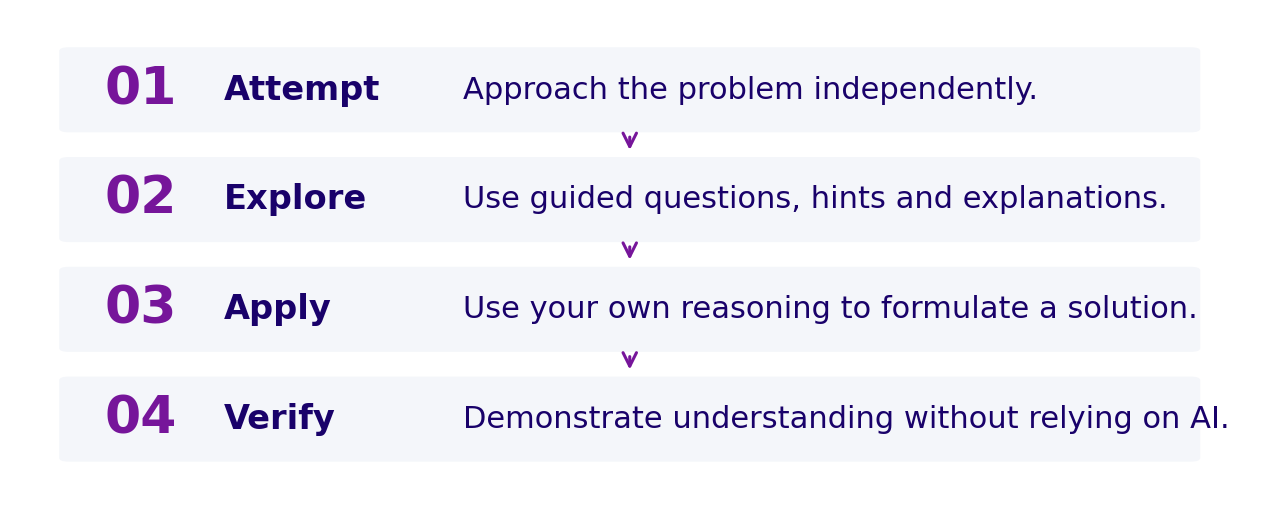
Attempt: approach independently. Explore: guided questions, hints and explanations. Apply: use own reasoning. Verify: demonstrate understanding without relying on AI.
The final stage is essential.
Educational technology must ultimately be evaluated against what learners can accomplish independently, rather than how well they perform while using it.
Children should learn to think with technology, not allow technology to think instead of them.
12. Artificial intelligence: Why educational design and guardrails matter
A particularly significant study published by Bastani and colleagues in the Proceedings of the National Academy of Sciences in 2025 investigated the effects of generative artificial intelligence on high school mathematics learning.
The study was a randomised field experiment conducted with close to 1,000 high school students at a large school in Turkey during the 2023–2024 school year.
The researchers compared conventional learning with relatively unrestricted AI assistance and an AI tutor designed with educational safeguards.
The results demonstrate why performance and learning must not be confused.
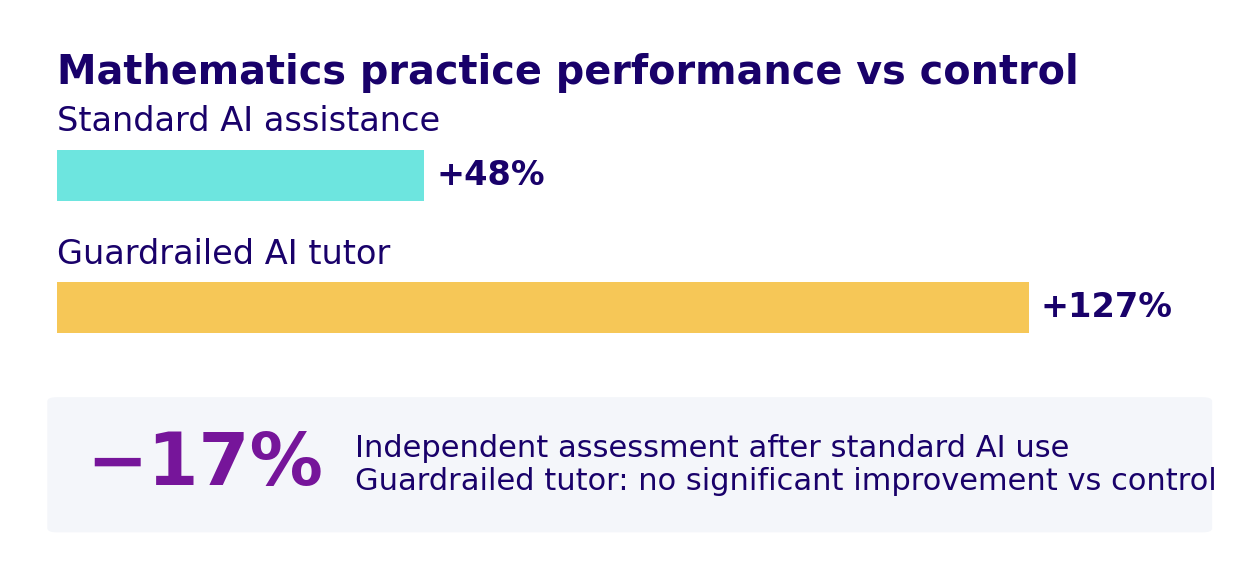
Mathematics practice performance relative to control: standard AI +48%, guardrailed AI tutor +127%. Subsequent independent assessment: standard AI −17%; the negative effect was largely mitigated among guardrailed tutor learners, with no statistically significant improvement over control.
These findings are particularly important.
A child can appear to perform exceptionally well while using artificial intelligence without necessarily acquiring the underlying intellectual ability.
However, the design of the AI experience can materially influence whether this occurs.
Why HelloAida was designed differently
General-purpose AI platforms are not necessarily designed around the developmental requirements of children, curriculum objectives or the principles of effective educational instruction.
They can provide immediate answers, complete assignments and generate sophisticated written responses.
For adults performing professional tasks, these capabilities can be valuable.
For children developing foundational intellectual skills, unrestricted access presents a different educational challenge.
At HelloAida, guided questioning, personalised explanations, curriculum alignment and age-appropriate educational safeguards are central to our philosophy.
Our objective is to help learners develop understanding rather than simply generate answers.
The Bastani study supports this design principle, although it does not independently validate HelloAida’s own product outcomes.
Because it was conducted with older secondary learners in a single Turkish school, its findings should also be read as evidence for a general design principle rather than as directly generalisable to South African classrooms or to younger learners.
The unintended consequence of banning educational AI
Children who are prohibited from using supervised educational AI at school may nevertheless encounter general-purpose AI through search engines, personal devices and unsupervised platforms at home.
This creates an important educational dilemma.
Should children’s first guided experiences with artificial intelligence take place within an educational environment, supported by teachers and appropriate safeguards?
Or should we leave children to develop their habits independently, using platforms that may be designed primarily around responding to requests rather than protecting the learning process?
At HelloAida, we believe responsible introduction is preferable to leaving children entirely unguided.
13. Digital citizenship: Avoidance is not education
Children are growing up in a world in which communication, employment, commerce, healthcare, education and entertainment increasingly involve digital technology.
Knowing how to navigate these environments responsibly is an essential life skill.
Digital citizenship extends far beyond knowing how to operate a device.
Competency | Educational objective |
Online privacy | Understanding which personal information must be protected |
Cybersecurity | Recognising scams and suspicious requests |
Information literacy | Distinguishing reliable information from misinformation |
Digital etiquette | Communicating responsibly and respectfully |
Cyberbullying | Recognising harmful behaviour and seeking assistance |
Digital footprints | Understanding the lasting consequences of online behaviour |
Intellectual property | Acknowledging sources and respecting copyright |
AI literacy | Recognising bias, inaccuracies and fabricated information |
Self-regulation | Knowing when technology is helpful and when to disengage |
Many of these competencies can be introduced offline through discussion, role-playing and classroom activities.
However, appropriately supervised practical experiences can help children learn to apply them.
Digital natives are not necessarily digitally literate
A child who knows how to navigate a gaming platform may have little understanding of the algorithms influencing their behaviour. A teenager who uses artificial intelligence confidently may be unable to identify fabricated information.
A learner who knows how to search the internet may not know how to evaluate whether a source is credible. Familiarity is not competence.
We cannot assume that children will acquire these essential skills independently through unsupervised exposure.
Protection and preparation must work together
We do not teach children water safety simply by preventing them from entering swimming pools.
We introduce them to water gradually, provide supervision, establish boundaries and teach them the skills necessary to become increasingly independent.
Digital education requires a similarly considered approach.
Some digital environments should remain off-limits to children. Others can be introduced gradually, purposefully and with appropriate supervision.
The objective is competence alongside protection.
14. Educating children for their future, not our past
A child entering Grade 1 in 2027 will ordinarily complete Grade 12 in 2038.
Should that child pursue a four-year university qualification, they may enter the professional workforce around 2043.
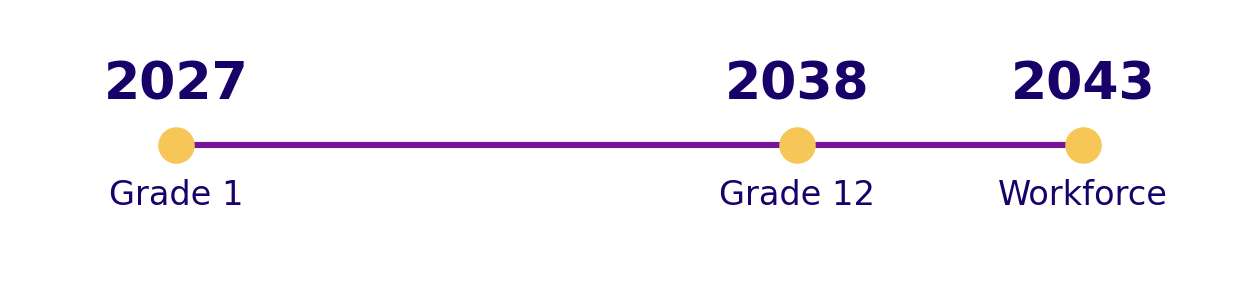
Illustrative educational journey: Grade 1 in 2027, Grade 12 in 2038, workforce around 2043.
What will employment look like at that point?
How will artificial intelligence have changed healthcare, engineering, finance, education, law, scientific research and creative industries?
What intellectual capabilities will employers value?
Nobody can predict precisely how the world will evolve over the next two decades.
However, technological competence is likely to form an important part of that future.
The changing nature of work
The World Economic Forum’s Future of Jobs Report 2025 estimates that 39% of workers’ existing skills will change or become outdated between 2025 and 2030.
Artificial intelligence, data analytics, cybersecurity and technological literacy are increasingly important.
However, employers also continue to value analytical thinking, creativity, adaptability, communication and resilience.
Human capabilities | Digital capabilities |
Critical thinking | AI literacy |
Creativity | Information evaluation |
Empathy | Cybersecurity awareness |
Communication | Data literacy |
Resilience | Digital creation |
Collaboration | Responsible automation |
Ethical judgment | Technological adaptability |
Independent reasoning | Human oversight |
Education should develop both categories of capabilities.
Source: World Economic Forum, The Future of Jobs Report 2025
Children are already using artificial intelligence
In February 2026, the Pew Research Center reported that 54% of American teenagers aged 13 to 17 had used AI chatbots for at least some assistance with schoolwork.
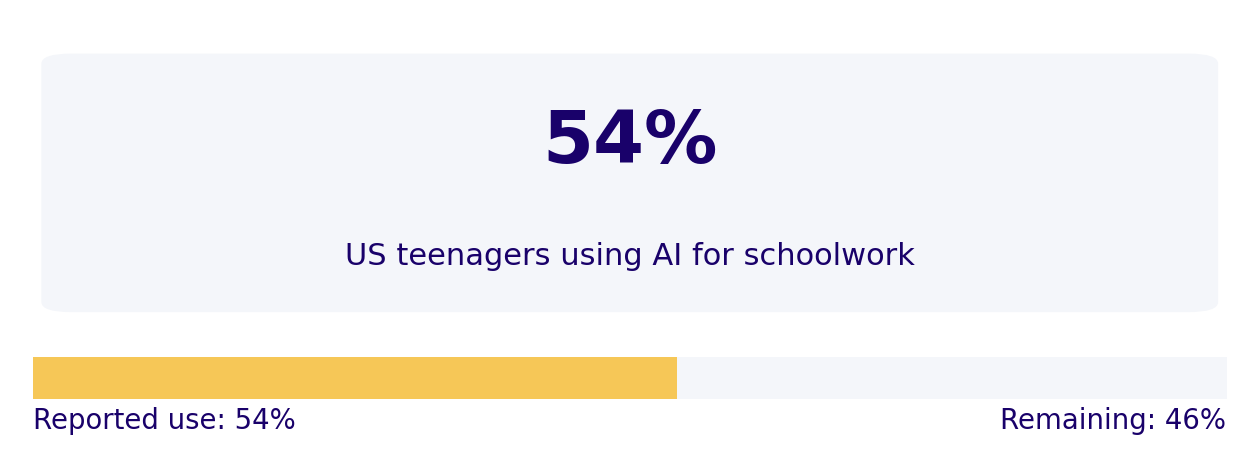
54% of surveyed US teenagers reported using AI chatbots for schoolwork assistance. Pew Research Center, February 2026. Not a South African prevalence estimate.
Children are not waiting for schools to decide whether AI belongs in education.
They are encountering it through search engines, general-purpose chatbots and other digital services.
The question is whether they are developing responsible habits.
Are they learning to question AI-generated information? Are they learning to recognise inaccuracies? Are they using AI to develop understanding or avoid intellectual effort?
If educational institutions withdraw entirely from AI literacy, they risk leaving children to develop these habits through unsupervised experimentation.
Source: Pew Research Center, How Teens Use and View AI, February 2026
AI literacy does not require unlimited AI access
UNESCO’s AI Competency Framework for Students identifies four dimensions of responsible AI education: human-centred thinking, ethics, technical understanding and AI system design.
UNESCO also recognises that younger children require appropriate limitations on independent interactions with generative AI.
These positions are compatible.
Children can learn about artificial intelligence through offline activities, teacher-led demonstrations, classroom discussions and appropriately safeguarded educational environments.
Preparing children for a technological future is not an argument for more screen time. It is an argument for better digital education.
Sources:
UNESCO, AI Competency Framework for Students, 2024
UNESCO, Guidance for Generative AI in Education and Research, 2023
15. Neurodiversity, accessibility and the unintended consequences of blanket device bans
An often-overlooked aspect of blanket device restrictions is their potential impact on children with different educational needs.
Children do not all learn at the same pace or under the same circumstances.
Appropriately selected technology can help remove barriers that conventional learning environments may not fully accommodate.
Learning need | Potential technological support |
Dyslexia | Text-to-speech and accessible reading resources |
Dysgraphia | Speech-to-text and alternative written expression |
Language barriers | Multilingual explanations and translation |
Visual impairments | Screen readers and magnification |
Hearing impairments | Captioning and transcription |
Learning anxiety | Private opportunities to practise and ask questions |
Different learning speeds | Personalised explanations and differentiated instruction |
Advanced learning needs | Additional intellectual challenges |
These applications must be individually evaluated.
Technology does not automatically improve outcomes for every neurodivergent learner, and some learners may require particularly strong safeguards against digital distraction. Nevertheless, blanket educational device restrictions risk removing accommodations that certain children need.
Consider a learner who understands scientific concepts but struggles to access a densely written textbook because of a reading difficulty.
A text-to-speech tool may allow that learner to demonstrate scientific understanding without being unnecessarily disadvantaged by an unrelated accessibility barrier. The educational objective determines whether the accommodation is appropriate.
At HelloAida, multilingual learning support, personalised explanations and alternative methods of interaction form part of our commitment to more inclusive education.
Equality does not necessarily mean giving every child identical resources. It means giving every child a meaningful opportunity to learn.
16. The South African context: Digital overexposure and digital exclusion
Much of the international debate about removing technology from schools takes place within relatively well-resourced communities.
South Africa faces a considerably different educational reality.
Many children lack access to private tutoring, reliable educational resources, individualised academic support and learning materials in their home languages.
South African public school classrooms often exceed 45 learners per teacher, with shortages most acute in mathematics, science and language subjects.
Many learners are taught in English despite it not being their home language, a mismatch that compounds the foundational literacy challenge documented below.
Our foundational learning crisis
The PIRLS 2021 results, released by the South African Department of Basic Education in 2023, revealed the extent of South Africa’s foundational literacy challenges.
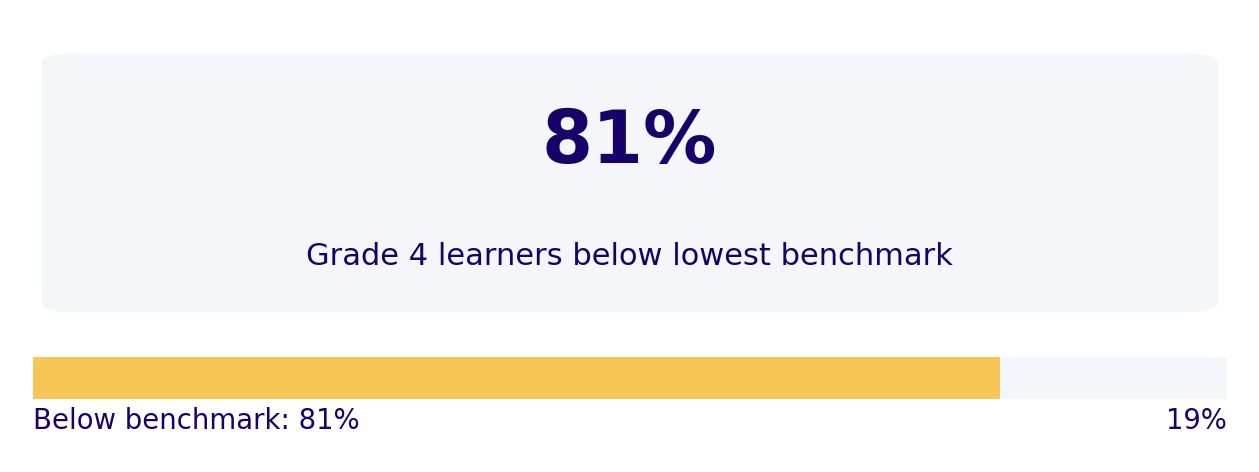
81% of South African Grade 4 learners did not reach the lowest international reading benchmark. PIRLS 2021 Main Report, published 2023.
Technology alone cannot solve this crisis.
Qualified teachers, foundational literacy instruction, appropriate books, educational infrastructure and early intervention remain indispensable.
However, carefully designed educational technology can potentially provide additional opportunities for personalised practice, multilingual explanations and accessible learning support.
This is one of the challenges HelloAida was established to address.
Source: South African Department of Basic Education, PIRLS 2021 Main Report
The promise and limits of multilingual AI
Research on AI-assisted learning in African school contexts shows real promise.
A 2025 World Bank randomised evaluation of a generative AI virtual tutor for secondary English learners in Edo State, Nigeria, found a learning effect of 0.23 standard deviations, with cost-effectiveness analysis showing gains equivalent to between 1.5 and 2 years of typical classroom progress.
A related evaluation of Rori, an AI-powered mathematics tutor delivered over WhatsApp in Ghana, is similarly cited in this literature as evidence that low-cost AI tutoring can improve outcomes in under-resourced school settings.
This promise comes with a genuine current limitation that deserves equally honest acknowledgement.
Large language models still perform less reliably in indigenous African languages than in English, which is why researchers have had to build dedicated frameworks, such as AfriLangTutor, to fine-tune models specifically for low-resource African languages rather than assuming general-purpose models would perform adequately.
A 2025 evaluation protocol found that language instructors generally rated generative AI output as weaker for low- and extremely low-resource languages than for high-resource ones.
This is why HelloAida generates multilingual explanations natively within the underlying language model rather than through a separate translation layer, a design choice intended to avoid the quality degradation documented above, and why multilingual quality should be expected to improve as the underlying models themselves do.
November 2026: UNICEF and EdTech Hub
The 2026 global report Shaping the Future of Digital Education considers both the opportunities and risks associated with educational technology.
It recognises that digital and AI-enabled technologies can support learning and inclusion but may also deepen inequality or cause harm when poorly implemented.
Its emphasis on evidence-based investment, teacher involvement, child protection and equitable access is particularly relevant to South Africa.
Source: UNICEF and EdTech Hub, Shaping the Future of Digital Education, 2026
The danger of creating two digital futures
Consider two children.
One attends a well-resourced school and has access to computers, reliable connectivity, private tutoring and parents capable of providing technological guidance.
The other attends an under-resourced school and depends largely on school for these opportunities. Removing educational technology from both schools may appear to establish an equal policy.
Its consequences may not be equal. The first child may continue developing digital competence and accessing educational support elsewhere.
The second child may lose an important opportunity. South Africa cannot afford to address digital overexposure while ignoring digital exclusion. We need to address both.
Technology should not create unnecessary financial burdens
Supporting educational technology does not mean that every learner needs an expensive personal device.
Shared classroom devices, computer laboratories, existing compatible equipment and school-provided resources can all support appropriate educational objectives.
Educational institutions should evaluate technology according to affordability, accessibility, educational value and safety.
Innovation should not become a marketing exercise or a mechanism for imposing unnecessary costs on families.
17. What educational technology companies must acknowledge
At HelloAida, we recognise that educational technology companies have responsibilities of their own.
We cannot demand evidence-based decision-making from parents and educators while exempting our industry from equivalent scrutiny.
There are legitimate concerns about educational technology that require serious consideration.
Printed books and reading comprehension
A 2018 meta-analysis by Delgado and colleagues identified an overall comprehension advantage for reading on paper compared with digital reading under certain conditions.
Printed books should remain central to education, particularly for sustained reading and deeper comprehension.
Digital resources should complement printed books rather than automatically replace them.
Source: Delgado et al., Don’t Throw Away Your Printed Books, Educational Research Review, 2018
Handwriting and foundational literacy
Children must continue developing handwriting, spelling, written organisation and independent expression.
Keyboard competence is an additional skill. It should not unnecessarily replace handwriting.
Particularly during the foundational years, children require regular opportunities to engage with physical learning materials.
Memory and independent knowledge
The research of Sparrow, Risko and Gilbert reinforces the importance of understanding how external tools influence cognitive strategies.
Foundational knowledge remains essential.
A learner cannot reliably evaluate information generated by artificial intelligence without sufficient understanding of the underlying subject.
Attention and concentration
Research published by Sana, Weston and Cepeda in 2013 examined the effects of laptop multitasking on classroom learning.
The researchers identified negative effects not only for individuals engaging in digital multitasking but also for nearby learners exposed to that distraction.
Although the study involved university students and should not automatically be generalised to primary school children, it provides an important argument for controlling digital distractions in educational environments.
Devices should be put away whenever they interfere with concentration or offer no meaningful educational advantage.
Physical development and wellbeing
Even educational technology can become excessive if it displaces exercise, outdoor play, sleep or meaningful interaction.
Educational purpose does not justify unlimited sedentary behaviour.
Privacy and safeguarding
Educational technology companies must protect children’s personal information, maintain appropriate safeguards, assess vulnerabilities and respond transparently to safety concerns.
In South Africa, this includes compliance with the Protection of Personal Information Act (POPIA), including its requirements concerning children’s personal information.
No educational technology provider should suggest that safeguards eliminate every possible risk.
Responsible technology requires ongoing assessment.
Educational outcomes must matter more than engagement
A learner spending more time on a platform is not necessarily learning more.
Completed activities, user engagement, streaks and time spent online must not be confused with educational improvement.
Technology providers must increasingly demonstrate whether children understand more, remember more and can apply that understanding independently.
The credibility of our industry depends on our willingness to be held accountable for these outcomes.
18. The HelloAida framework for responsible educational technology
Rather than advocating unrestricted technology use or blanket restrictions, HelloAida proposes a developmental approach that gradually introduces technological competence while protecting foundational learning.
These recommendations represent our educational position, rather than clinically validated daily screen-time prescriptions.
Foundation Phase: Grades R to 3
The principal objective should be foundational cognitive, emotional, social and physical development.
Children should spend the overwhelming majority of their educational time engaged in physical learning experiences, handwriting, reading, numeracy, storytelling, exploration, creativity and play.
Technology should be minimal, selective and adult-directed.
Independent access to general-purpose AI platforms and unrestricted personal smartphones should not be educational requirements.
Intermediate Phase: Grades 4 to 6
Children can begin developing structured digital literacy through carefully supervised activities.
Appropriate applications may include curriculum-aligned practice, teacher-directed research, creative projects, keyboard proficiency and guided information evaluation. AI literacy should be age-appropriate, supervised and supported by appropriate safeguards.
Printed reading, handwriting, mental arithmetic and independent assessments should remain central.
Senior Phase: Grades 7 to 9
Learners should gradually develop more independent digital competencies, including research skills, data literacy, digital collaboration, cybersecurity and critical evaluation of information.
They should learn to distinguish responsible AI assistance from academic dishonesty. Technology should be available when educationally appropriate and put away when it is not.
Further Education and Training Phase: Grades 10 to 12
Learners should develop more sophisticated technological competencies in preparation for tertiary education, employment and independent decision-making.
Appropriate activities may include advanced research, programming, data analysis, digital projects and responsible AI-supported workflows.
Students should routinely demonstrate their independent intellectual capabilities through assessments where technological assistance is appropriately restricted.
Educational phase | Educational technology | AI literacy |
Grades R–3 | Minimal and adult-directed | Basic conceptual awareness |
Grades 4–6 | Selective and supervised | Guided, age-appropriate experiences |
Grades 7–9 | Structured and increasingly independent | Critical and ethical application |
Grades 10–12 | Purposeful and increasingly independent | Advanced responsible application |
Accessibility requirements should be considered throughout every developmental stage.
19. A shared digital responsibility charter
Rather than transferring responsibility between parents and schools, we encourage both to establish clear commitments.
School responsibility charter
☐ Use technology only where there is a defined learning objective.
☐ Protect handwriting, printed reading and foundational knowledge.
☐ Restrict personal smartphones and recreational applications.
☐ Maintain appropriate content controls and safeguarding measures.
☐ Train teachers in responsible digital education.
☐ Protect recess, sport, play and physical activity.
☐ Measure independent educational outcomes.
☐ Communicate transparently about actual classroom device usage.
☐ Avoid unnecessary financial burdens on families.
☐ Accommodate individual accessibility requirements.
☐ Teach digital citizenship and age-appropriate AI literacy.
☐ Discontinue technology that fails to demonstrate sufficient educational value.
Family responsibility charter
☐ Establish age-appropriate recreational screen-time boundaries.
☐ Delay unrestricted smartphone ownership where appropriate.
☐ Apply strong social media restrictions.
☐ Maintain parental controls and content safeguards.
☐ Keep unnecessary devices out of bedrooms at night.
☐ Protect screen-free family meals and conversations.
☐ Make time for outdoor activities and physical exercise.
☐ Encourage unstructured play and independence.
☐ Create opportunities for creativity and shared experiences.
☐ Model healthy digital behaviour.
☐ Understand how children are using artificial intelligence.
☐ Maintain open communication about children’s online experiences.
Schools can support families through workshops, parental control education and digital citizenship programmes. Parents can support schools by reinforcing responsible technology habits at home. The objective should be consistency across children’s environments.
20. Moving beyond fear-driven educational policy
Public discussions about childhood and technology are understandably emotional. Parents want to protect their children. Educators want effective learning environments. Technology providers want to demonstrate the benefits of innovation.
However, education policy should be based on evidence rather than fear, nostalgia or commercial enthusiasm. When research is presented as evidence for banning devices, we encourage parents and educators to ask the following questions.
Research question | Why it matters |
What type of device was studied? | Smartphones and educational computers are not identical. |
What activity was undertaken? | Social media differs from curriculum-based learning. |
What age were the participants? | Adolescent findings may not apply to younger children. |
Was usage supervised? | Guidance may influence educational outcomes. |
How much technology was used? | Excessive exposure differs from limited use. |
Was the research experimental? | Observational evidence cannot independently establish causation. |
What outcomes were measured? | Mental health, attention and academic achievement are different outcomes. |
What activities were displaced? | Technology replacing sleep differs from technology supporting instruction. |
Was the research peer-reviewed? | Preliminary findings require appropriate caution. |
The emotional power of a bestselling book should not replace scientific scrutiny.
Equally, promises of technological transformation should not replace independent evidence of educational benefit.
Perhaps the most important lesson emerging from more than two decades of research is that technology cannot be evaluated as a single, uniform exposure.
Even researchers advocating stronger restrictions recognise that combining fundamentally different digital activities can distort scientific conclusions.
If we accept this principle when evaluating the harms of social media, we must also accept it when evaluating educational technology.
We cannot demand scientific precision when investigating the risks of technology and then abandon that precision when deciding what to ban in our schools.
Conclusion: Beyond the anxious generation, raising the capable generation
Jonathan Haidt has challenged society to reconsider the childhood experiences we are providing for our children.
We believe this conversation is necessary. However, we also believe it needs to evolve.
The answer to an anxious generation is not necessarily an entirely disconnected generation.
It is a generation that understands technology without becoming controlled by it.
A generation that enjoys friendships, explores the physical world, reads deeply, thinks independently, communicates effectively and engages responsibly with powerful technological tools.
A generation that understands artificial intelligence without surrendering its intellectual independence.
A generation that knows when technology is useful, when it is unnecessary and when it is harmful.
Parents are right to be concerned about excessive digital exposure, social media, fragmented attention and the disappearance of play-based childhood.
They are right to expect schools to demonstrate responsible technology use.
They are right to challenge educational practices that unnecessarily replace textbooks, handwriting, human interaction or independent thinking.
However, where schools are using educational technology selectively, responsibly and for demonstrable educational purposes, the evidence does not establish that blanket technological prohibition is the best solution.
More than two decades of research demonstrate that technology can influence learning, memory, attention and wellbeing in different ways.
Sparrow and colleagues demonstrated that access to external information can change memory strategies.
Risko and Gilbert provided a scientific framework for understanding cognitive offloading.
Yogman and colleagues established the importance of protecting play and human connection.
Odgers, Orben, Przybylski and the National Academies challenged overly simplistic interpretations of the relationship between technology and mental health.
The SMART Schools researchers and the subsequent Icelandic research highlighted the limitations of relying exclusively on school phone restrictions to address broader developmental challenges.
Research continuing through November 2026 demonstrates that important academic disagreements remain unresolved.
Together, these findings support a more considered approach.
Parents must make time for their children.
Schools must protect foundational learning.
Technology companies must design products that serve children’s educational and developmental interests.
Educators must prepare children for the world they will inherit.
We cannot outsource responsible parenting to school device policies, just as we cannot outsource responsible digital education to children themselves.
At HelloAida, we do not believe children should spend their childhoods in front of screens.
We also do not believe they should emerge from their education technologically unprepared.
Children deserve the very best of traditional education, strengthened by the carefully considered opportunities of technological innovation.
They deserve to learn through books, pencils, conversation, creativity, physical experiences and human relationships.
They also deserve to develop the confidence and competence necessary to navigate an increasingly digital world.
These objectives are not mutually exclusive.
We must protect children from technologies designed to consume their attention while teaching them how to use technologies that can expand their intellectual capabilities.
Let us ban distraction, not discovery.
Let us restrict digital consumption without restricting intellectual opportunity.
Let us protect childhood without compromising future preparedness.
And let us teach children not simply how to use technology, but how to remain curious, thoughtful, capable and independent in a world increasingly shaped by it.
That is the generation we want to help raise at HelloAida.
Academic references and supporting research
Foundational research: 2003–2020
Ellington (2003). A Meta-Analysis of the Effects of Calculators on Students’ Achievement and Attitude Levels in Precollege Mathematics Classes. Journal for Research in Mathematics Education. Source
Tamim et al. (2011). What Forty Years of Research Says About the Impact of Technology on Learning. Review of Educational Research. Source
Sparrow, Liu & Wegner (2011). Google Effects on Memory: Cognitive Consequences of Having Information at Our Fingertips. Science, 333, 776–778. Source
Sana, Weston & Cepeda (2013). Laptop Multitasking Hinders Classroom Learning for Both Users and Nearby Peers. Computers & Education. Source
Risko & Gilbert (2016). Cognitive Offloading. Trends in Cognitive Sciences, 20, 676–688. Source
Beland & Murphy (2016). Ill Communication: Technology, Distraction & Student Performance. Labour Economics. Source
Yogman et al. (2018). The Power of Play: A Pediatric Role in Enhancing Development in Young Children. Pediatrics. Reaffirmed January 2025. Source
Delgado et al. (2018). Don’t Throw Away Your Printed Books: A Meta-Analysis on the Effects of Reading Media on Reading Comprehension. Educational Research Review. Source
Orben & Przybylski (2019). The Association Between Adolescent Well-Being and Digital Technology Use. Nature Human Behaviour. Source
Muralidharan, Singh & Ganimian (2019). Disrupting Education? Experimental Evidence on Technology-Aided Instruction in India. American Economic Review. Source
Education Endowment Foundation (2019). Using Digital Technology to Improve Learning. Source
Contemporary research and academic debate: 2022–2024
Pedersen et al. (2022). Effects of Limiting Recreational Screen Media Use on Physical Activity and Sleep in Families With Children. JAMA Pediatrics. Source
OECD (2023). PISA 2022 Results, Volume II. Source
UNESCO (2023). Guidance for Generative AI in Education and Research. Source
South African Department of Basic Education (2023). PIRLS 2021 Main Report. Source
Haidt (2024). The Anxious Generation. Source
Odgers (2024). The Great Rewiring: Is Social Media Really Behind an Epidemic of Teenage Mental Illness? Nature. Source
Spikes (2024). Social-Media Influence on Teen Mental Health Goes Beyond Just Cause and Effect. Nature. Source
Thorp (2024). Unsettled Science on Social Media. Science. Source
National Academies of Sciences, Engineering and Medicine (2024). Social Media and Adolescent Health. Source
University of Virginia (2024). Mental Health and Social Media: Haidt and Odgers Debate. Source
Schmidt-Persson et al. (2024). Screen Media Use and Mental Health of Children and Adolescents. JAMA Network Open. Source
UNESCO (2024). AI Competency Framework for Students. Source
Recent research and policy developments: 2025–2026
Goodyear et al. (2025). School Phone Policies and Their Association With Mental Wellbeing, Phone Use, and Social Media Use (SMART Schools). The Lancet Regional Health – Europe. Source
Bastani et al. (2025). Generative AI Without Guardrails Can Harm Learning: Evidence From High School Mathematics. PNAS. Source
World Economic Forum (2025). The Future of Jobs Report 2025. Source
Capraro et al. (2025, revised September 2026). A Collective Review on Some Potential Negative Impacts of Smartphone and Social Media Use on Adolescent Mental Health: Results From a Delphi Process. Working paper. Source
American Academy of Pediatrics (2026). Digital Ecosystems, Children, and Adolescents: Policy Statement. Source
American Academy of Pediatrics (2026). Digital Ecosystems, Children, and Adolescents: Technical Report. Source
Pew Research Center (2026). How Teens Use and View AI. Source
American Psychological Association (2026). Children’s and Adolescents’ Learning With Educational Technology. Source
UNESCO (2026). How Many Countries Have Phone Bans in School? Updated September 2026. Source
Haidt & Rausch (2026). Social Media Is Harming Adolescents at a Scale Large Enough to Cause Changes at the Population Level. World Happiness Report. Source
Al-Jbouri et al. (2026). Screen Use and Child and Adolescent Development and Mental Health Outcomes. JAMA Pediatrics. Source
Haidt & Rausch (October 2026). Two Practices That Understate the Mental Health Risks Associated With Adolescent Social-Media Use. Perspectives on Psychological Science. Source
Bonilla Aparicio et al. (October 2026). School Phone Bans and Adolescent Mental Health in Iceland. JAMA Network Open. Source
Allcott et al. (October 2026). The Effects of School Phone Bans: National Evidence From Lockable Pouches. Quarterly Journal of Economics. Source
UNICEF & EdTech Hub (2026). Shaping the Future of Digital Education. Source
Ferguson et al. (November 2026). No Clear Consensus Among Clinicians and Clinical Researchers Regarding Social Media and Youth Mental Health. Discover Psychology. Source
Henkel, Horne-Robinson, Kozhakhmetova and Lee (2024). Effective and Scalable Math Support: Experimental Evidence on the Impact of an AI Math Tutor in Ghana. Rori (preprint). Source
De Simone et al. (2025). From Chalkboards to Chatbots: Evaluating the Impact of Generative AI on Learning Outcomes in Nigeria. World Bank Policy Research Working Paper 11125. Source
Belay et al. (2026). AfriLangTutor: Advancing Language Tutoring and Culture Education in Low-Resource Languages with Large Language Models. Preprint. Source
Swinehart, Nguyen and Yeh (2025). A Protocol for Evaluating AI Chatbots’ Capabilities for Low-Resource Language Teachers. Language Learning and Technology. Source
Research methodology and declaration of interest
This publication is a research-informed position paper produced by HelloAida, a South African educational technology company with a commercial interest in responsible AI-assisted education.
This paper was researched and authored by Leora Hessen, Founder and CEO of HelloAida, Emma Sokolsky, Head of Education and a qualified teacher and educational psychologist, Melissa Slaymaker, Chief Operating Officer, and Mpho Hlalele, Head of Technology Implementation.
It draws on selected peer-reviewed studies, clinical reports, experimental research, meta-analyses, observational studies, academic commentaries, international policy guidance and survey research.
It is a narrative review rather than a systematic literature review or independently peer-reviewed academic publication.
Earlier studies are included because they provide foundational evidence relevant to learning, memory, play and cognitive development. Recent studies are included to examine contemporary technologies, educational interventions and policy developments.
Research concerning school device restrictions remains more extensive for adolescents than younger primary school learners. Direct research comparing blanket educational computer bans with limited, supervised educational technology remains comparatively limited.
Evidence supporting particular educational interventions should not automatically be interpreted as independent validation of all educational technology products.
HelloAida’s recommendations represent its educational position and should not be interpreted as independently validated clinical guidelines.
About HelloAida
HelloAida is a South African, multilingual, curriculum-aligned AI learning platform designed to support learners, teachers and families.
Our educational philosophy prioritises guided learning, personalised explanations, responsible AI use and the development of critical and independent thinking.
We believe technology should empower teachers, support parents and help children become confident, capable and increasingly independent learners.
HelloAida. Protecting childhood. Developing independent thinkers. Preparing the capable generation.